Real Celebrities Never Die!
OR
Search For Past Celebrities Whose Birthday You Share
Died Age: 70
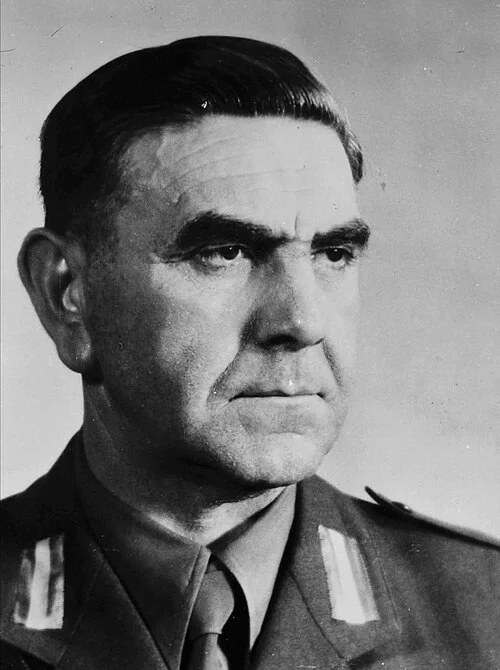
wikipedia.org
Ante Pavelić
Birthday:
13 Jul, 1889
Date of Death:
26 Dec, 1959
Cause of death:
Gunshot
Nationality:
Croatian
Famous As:
Lawyer
Age at the time of death:
70
Ante Pavelić's Quote's

“Independence is worth any price.”
Ante Pavelić
🔗 deadcelebrityhub.com
Ante Pavelić: Early Life and Education
Ante Pavelić was born on July 14, 1889, in the village of Bradina, located in Herzegovina, which was then part of Austria-Hungary. His early life unfolded in a region marked by ethnic diversity and political tensions, shaping his nationalist ideals from a young age. Pavelić identified strongly with his Croatian heritage and would later dedicate his life to the cause of Croatian independence. Ante Pavelić grew up in a modest family environment that instilled in him a sense of determination. Seeking opportunities beyond his rural upbringing, he moved to Zagreb to pursue higher education. There, he studied law and developed a keen interest in politics. His formative years were marked by his involvement with the Croatian Party of Rights (HSP), a nationalist organization advocating for greater autonomy for Croatia within the Kingdom of Serbs, Croats, and Slovenes. By 1918, Pavelić had risen to prominence within the party as one of its leaders, demonstrating his strong commitment to Croatian sovereignty.
Personal Life
Ante Pavelić married Maria Lovrenčević, who remained by his side throughout his tumultuous political career. Despite the challenges posed by his radical activities and frequent exiles, their union endured. While little is documented about their personal interactions, Maria’s presence provided stability amidst Pavelić’s often chaotic life.
Political Career and Rise to Prominence
Pavelić’s professional journey began as a lawyer in Zagreb, but his political ambitions quickly overshadowed his legal career. In 1921, he was elected as a municipal councilor for Zagreb and later became a deputy in the Yugoslav parliament in 1927. His fiery rhetoric and staunch opposition to centralization earned him recognition as a leading advocate for Croatian independence. However, Pavelić’s methods became increasingly radical over time. Following King Alexander I’s declaration of dictatorship in 1929, he fled Yugoslavia and sought refuge abroad. In Italy, he founded the Ustaše movement—a revolutionary nationalist organization dedicated to creating an independent Croatian state through violent means. The Ustaše gained notoriety for its terrorist activities, including bombings and assassinations. One of their most infamous acts was the assassination of King Alexander I in Marseille in 1934, orchestrated by Pavelić in collaboration with Macedonian nationalists.
Leadership of the Independent State of Croatia
The turning point in Pavelić’s career came during World War II. After the Axis powers invaded Yugoslavia in April 1941, Nazi Germany and Fascist Italy appointed Pavelić as the leader (Poglavnik) of the newly established Independent State of Croatia (NDH). Under his regime, Croatia became a puppet state subservient to Axis interests. Pavelić’s government implemented policies inspired by fascist ideology, including widespread persecution of Serbs, Jews, Roma, and political opponents. His regime was responsible for atrocities that included forced conversions to Catholicism, mass killings, deportations to concentration camps, and property confiscation. These actions contributed to genocides such as the Holocaust and Porajmos within Croatia.
Exile and Death
As World War II drew to a close in 1945, Pavelić fled Croatia ahead of advancing Allied forces. He initially sought refuge in Austria before relocating to Argentina under an assumed identity. Despite living in exile, he remained active within Croatian nationalist circles abroad. In 1957, Pavelić survived an assassination attempt that left him severely injured. Seeking medical treatment and safety, he moved to Spain where he lived until his death on December 28, 1959. He succumbed to injuries sustained during the attack while residing in Madrid.
Legacy
Ante Pavelić remains one of the most controversial figures in Croatian history. While some view him as a champion of Croatian nationalism who fought for independence against Yugoslav centralization, others condemn him for leading a fascist regime responsible for war crimes and genocide. His legacy is deeply polarizing and continues to provoke debate among historians and political commentators.
Profile Snapshot
Name:
Ante Pavelić
Popular Name:
Ante Pavelić
Gender:
Male
Cause of Death:
Gunshot
Spouse:
Maria Lovrenčević
Place of Birth:
Bradina, Bosnia and Herzegovina, Austria-Hungary (now Bosnia and Herzegovina)
Place of Death:
Madrid, Spain
Occupation / Profession:
Lawyer
Nationalist Leader
Politician
Personality Type
Commander: Bold, imaginative and strong-willed leaders, always finding a way – or making one. He was known for strategic vision, dominance, and control.
Ante Pavelić's Interesting Facts
He orchestrated the 1934 assassination of Yugoslav King Alexander I.
He survived an assassination attempt in 1957 in Argentina.
His regime killed hundreds of thousands in concentration camps like Jasenovac.
Pavelić fled to Argentina after WWII, living under aliases.
Achievements & Awards
Authored nationalist writings and manifestos.
Became Poglavnik of the Independent State of Croatia (1941–1945).
Founded the Ustaše movement in 1929.
Received the Order of the Crown of King Zvonimir (NDH decoration).
Secured Croatian independence under Axis support.
External Links
Additional Links
https://en.citizendium.org/wiki/Ante_Paveli%C4%87https://encyclopedia.ushmm.org/content/en/film/croatian-fascist-leader-ante-pavelichttps://www.britannica.com/biography/Ante-Pavelichttps://www.jewishvirtuallibrary.org/ante-pavelichttps://www.sciencespo.fr/mass-violence-war-massacre-resistance/en/document/pavelic-1889-1959-ante.htmlhttps://www.yadvashem.org/odot_pdf/Microsoft%20Word%20-%205705.pdf
Latest Profiles
People also viewed
Gerald Ford
Born14 Jul, 1913
Died26 Dec, 2006
NationalityAmerican
Age at time of death93
Victor Hugo
Born26 Feb, 1802
Died22 May, 1885
NationalityFrench
Age at time of death83
George Murphy
Born04 Jul, 1902
Died03 May, 1992
NationalityAmerican
Age at time of death89
P. T. Barnum
Born05 Jul, 1810
Died07 Apr, 1891
NationalityAmerican
Age at time of death80
Rajendra Prasad
Born03 Dec, 1884
Died28 Feb, 1963
NationalityIndian
Age at time of death78
Thurgood Marshall
Born02 Jul, 1908
Died24 Jan, 1993
NationalityAmerican
Age at time of death84
Nelson Rockefeller
Born08 Jul, 1908
Died26 Jan, 1979
NationalityAmerican
Age at time of death70

Ethan Allen
Born21 Jan, 1738
Died12 Feb, 1789
NationalityAmerican
Age at time of death51
John Loud
Born02 Nov, 1844
Died10 Aug, 1916
NationalityAmerican
Age at time of death71
Herbert Hoover
Born10 Aug, 1874
Died20 Oct, 1964
NationalityAmerican
Age at time of death90
Antoine Lavoisier
Born26 Aug, 1743
Died08 May, 1794
NationalityFrench
Age at time of death50
Jacques Delors
Born20 Jul, 1925
Died27 Dec, 2023
NationalityFrench
Age at time of death98
James Harrison
Born17 Apr, 1816
Died03 Sep, 1893
NationalityScottish,Australian
Age at time of death77
Menachem Begin
Born16 Aug, 1913
Died09 Mar, 1992
NationalityIsraeli
Age at time of death78
Peter Fraser
Born28 Aug, 1884
Died12 Dec, 1950
NationalityNew Zealand
Age at time of death66
Muhammad Ali Jinnah
Born25 Dec, 1876
Died11 Sep, 1948
NationalityPakistani
Age at time of death71
Pablo Escobar
Born01 Dec, 1949
Died02 Dec, 1993
NationalityColombian
Age at time of death44
Booker T. Washington
Born05 Apr, 1856
Died14 Nov, 1915
NationalityAmerican
Age at time of death59
John Dickinson
Born13 Nov, 1732
Died14 Feb, 1808
NationalityAmerican
Age at time of death75
George Mason
Born11 Dec, 1725
Died07 Oct, 1792
NationalityAmerican, British
Age at time of death66