Real Celebrities Never Die!
OR
Search For Past Celebrities Whose Birthday You Share
Died Age: 83
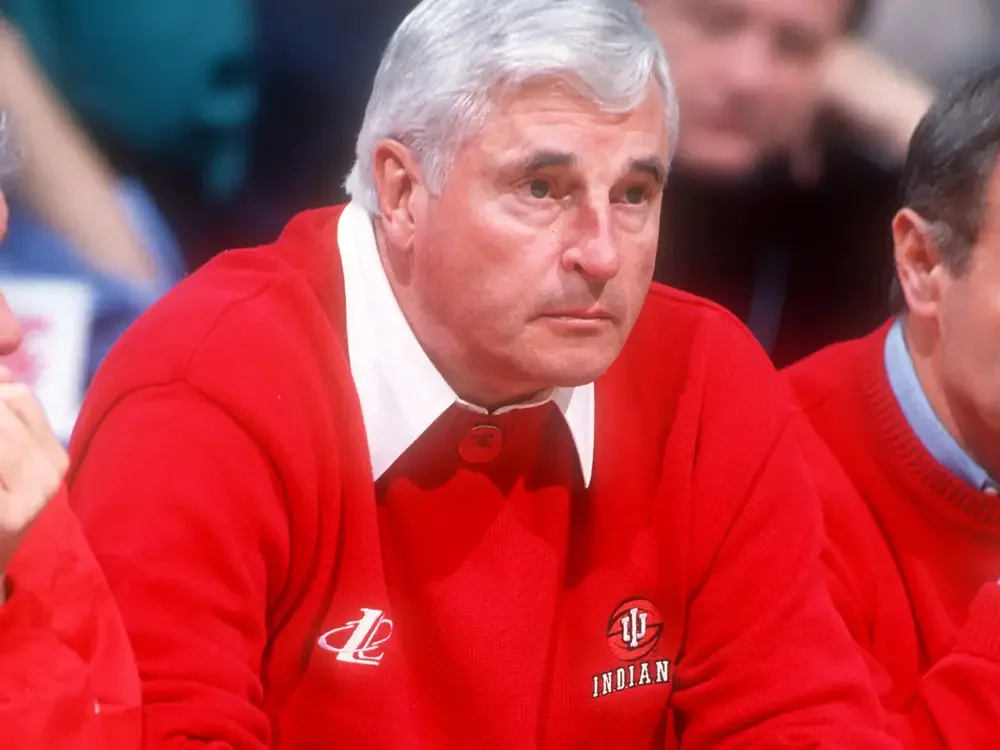
i.insider.com
Bob Knight
Birthday:
25 Oct, 1940
Date of Death:
01 Nov, 2023
Cause of death:
Dementia complications coupled with Pneumonia
Nationality:
American
Famous As:
Basket Coach
Age at the time of death:
83
Robert Montgomery Knight's Quote's

“Discipline is doing what you have to do and doing it as well as you possibly can, and doing it that way all the time.”
Robert Montgomery Knight
🔗 deadcelebrityhub.com
Early Life: A Foundation of Discipline and Drive
Bob Knight was a basketball coach who was fiercely disciplined, unapologetically demanding, and obsessively committed to the game of basketball. He redefined what it meant to lead a college team. Known as “The General” for both his military bearing and ironclad leadership, Knight was a coach who inspired fierce loyalty and fierce controversy in equal measure. But love him or loathe him, his legacy is undeniable: a brilliant basketball mind who forged champions and never backed down from his principles, even when the world pushed back.
Born on October 25, 1940, in the small steel town of Massillon, Ohio, Robert Montgomery Knight grew up in nearby Orrville, where the values of hard work, loyalty, and toughness ran deep. Raised by a single mother after his father passed away when Bob was young, he developed a tenacity early on an emotional and physical level that would come to define him.
From the beginning, basketball was more than a game for Knight but a blueprint for life. As a teenager, he was already known for his competitive fire and meticulous preparation. While other kids played for fun, Knight studied plays, analysed opponents, and obsessed over the intricacies of the sport. It wasn’t just about winning; it was about mastery.
A lesser-known fact: Knight was also a talented baseball player, and his strategic mind easily adapted to different sports. But basketball called to him with a force he couldn’t ignore.
Education: West Point and the Making of a Leader
Knight's destiny took a defining turn when he enrolled at Ohio State University. There, he played under legendary coach Fred Taylor and was part of the 1960 national championship team, alongside future Hall of Famers Jerry Lucas and John Havlicek. Though he came off the bench, Knight soaked up the game like a sponge, learning the value of systems, spacing, and selflessness.
But it was his decision to start coaching at the United States Military Academy at West Point in 1965—at just 24 years old—that truly shaped his ethos. At West Point, Knight’s coaching persona crystallised. The military atmosphere fused perfectly with his personality: precise, demanding, and utterly focused. Beyond just teaching basketball, he was moulding young men for life.
Career Journey: From Young Coach to Living Legend
Early Career: Building the Foundation at West Point
At West Point, Knight coached future Duke legend Mike Krzyzewski and developed a coaching philosophy rooted in discipline and motion offence. His teams may not have had top-tier talent, but they were always prepared, always sharp. That sharpness caught the attention of Indiana University.
Indiana Years: Glory, Grit, and Controversy (1971–2000)
Knight’s time at Indiana is the stuff of legend and headlines. He took over in 1971 and immediately began rebuilding the program with a steely focus. In 1976, he led the Hoosiers to a perfect season—32-0—a feat that remains unmatched in men’s college basketball. Under Knight, Indiana won three national championships (1976, 1981, 1987) and established itself as a perennial powerhouse.
He was a master tactician, especially revered for his motion offence and man-to-man defence. Players who bought into his system thrived, not only on the court but also in life. Many went on to be successful coaches, businessmen, and leaders.
But Knight was also known for his volcanic temper. He threw chairs, clashed with administrators, and never softened his approach. He saw himself as a protector of the game’s purity, often railing against what he saw as the erosion of discipline and academic standards in college sports. His unwavering adherence to his principles frequently put him at odds with authority, culminating in his controversial firing from Indiana in 2000.
Texas Tech and Later Career: The Teacher Endures
Knight wasn’t done. In 2001, he accepted the head coaching job at Texas Tech University. Many saw it as a final act, but Knight proved otherwise. He transformed the struggling program and led the Red Raiders to four NCAA tournaments, demonstrating that his methods remained effective in the modern game.
In 2008, he retired mid-season, handing the reins to his son Pat. His final win count? 902—the most in NCAA Division I men’s basketball history at the time.
Personal Life: Complex, Private, and Fiercely Loyal
Away from the court, Knight was a man of contradictions. He loved classical music, collected books on military history, and could recite Shakespeare from memory. He was fiercely private and valued loyalty above all else. To his inner circle, he was warm, thoughtful, even tender. To outsiders, he could be abrasive and combative.
He married twice and had two sons, including Pat, who followed in his footsteps as a coach. Knight’s loyalty to his former players was legendary, as he never forgot those who stood by him. He was known to help retired athletes in quiet, generous ways, far from the spotlight.
A little-known trivia: Knight once saved a drowning man while fishing in Michigan—then refused to talk about it publicly. “I did what anyone should do,” he later shrugged.
Legacy: A Titan, Flawed and Fierce
Bob Knight’s legacy is as complex as the man himself. He won games—hundreds of them. He changed the lives of countless young athletes. He reshaped the way basketball was taught and understood. But he also challenged norms, defied authority, and left a trail of controversy in his wake.
What remains indisputable is the scale of his influence. His insistence on academic excellence, player development, and the sanctity of the game left an indelible mark on college basketball. His former players, even those who clashed with him, often credit him for teaching them not just about sports, but about integrity, preparation, and resilience.
When Knight passed away in 2023, the tributes poured in, not just from the world of sports but from anyone who had ever been shaped by a mentor who refused to compromise. Love him or not, Bob Knight was unforgettable.
Profile Snapshot
Name:
Robert Montgomery Knight
Popular Name:
Bob Knight
Gender:
Male
Cause of Death:
Dementia complications coupled with Pneumonia
Spouse:
Karen Vieth Edgar
Nancy Falk
Place of Birth:
Massillon, Ohio, United States
Place of Death:
Bloomington, Indiana, United States
Occupation / Profession:
Basket Coach
Basket Player
Personality Type
Commander Bold, imaginative and strong-willed leaders, always finding a way – or making one Bob Knight was an authoritarian, driven leader who believed in discipline, demanded excellence, and never backed down from doing things his way.
Robert Montgomery Knight's Interesting Facts
He had a deep love for history and often gave players reading assignments from military books.
Knight made a cameo appearance in the 2003 film Anger Management, playing a therapist.
Knight was once ejected from a game before it even started—during warm-ups—for arguing with a referee.
Achievements & Awards
Bob Knight won 902 NCAA Division I games, making him the winningest men's college basketball coach at the time of his retirement.
He also coached the U.S. Olympic team to a gold medal in 1984, with a young Michael Jordan on the roster.
He led Indiana University to three national championships (1976, 1981, 1987), including the last undefeated season in men’s college basketball history in 1976.
Knight was named National Coach of the Year four times and was inducted into the Naismith Memorial Basketball Hall of Fame in 1991.