Real Celebrities Never Die!
OR
Search For Past Celebrities Whose Birthday You Share
Died Age: 44
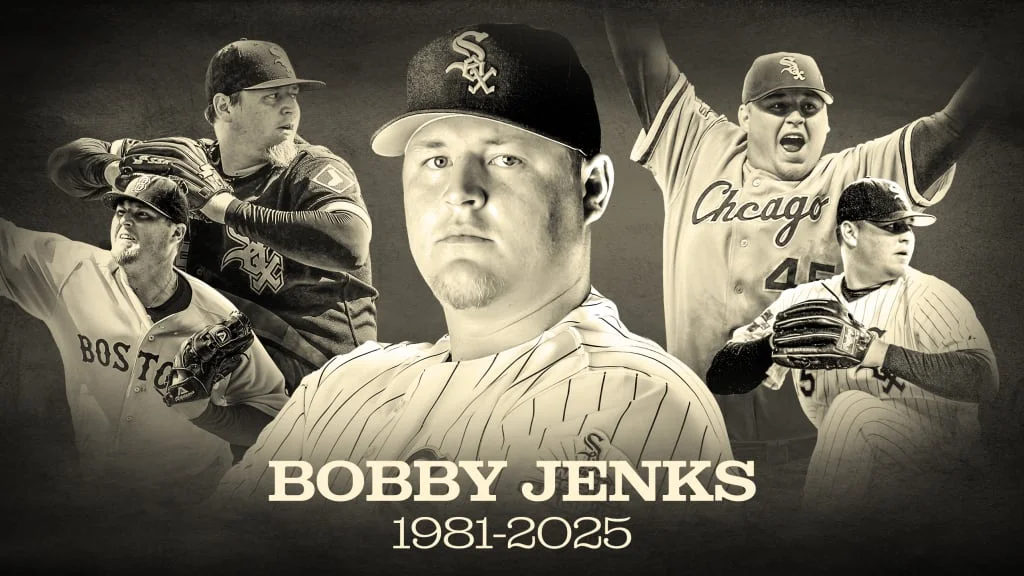
www.mlb.com
Bobby Jenks
Birthday:
13 Mar, 1981
Date of Death:
03 Jul, 2025
Cause of death:
Stomach cancer
Nationality:
American
Famous As:
American professional baseball pitcher
Age at the time of death:
44
Robert Scott Jenks 's Quote's

“It was like smoking crack — the more you do it, the more you want to do it.”
Robert Scott Jenks
🔗 deadcelebrityhub.com
Early Life
Bobby Jenks was a fire-breathing closer, a warrior on the mound whose fastball rattled bats, but also a man whose battles, off the field, revealed just as much courage. He played a key role in ending an 88-year championship drought for the Chicago White Sox, rose to superstar status in relief, then weathered injury, addiction, and illness with a resilience that made his life story both triumphant and deeply human. He is remembered not just for the saves, but for the grit, the heart, and the vulnerability behind the spotlight.
Robert Scott “Bobby” Jenks was born on March 14, 1981, in Mission Hills, a neighborhood in the San Fernando Valley of Los Angeles. His parents—his father working in roofing, his mother as a store clerk—didn’t have huge fame or fortune, but they raised a boy who loved baseball like it was a language. At some point during his youth the family moved to Idaho, and Jenks attended Lakeland High School there, a setting far from big-city glamour but one in which talent and hard work speak loudly when you throw a 100-mph fastball.
Even early on, Jenks showed physical gifts—size, strength, velocity—but he also had to contend with limitations: lack of academic standing held him back from college baseball, and his path to the majors was anything but smooth.
Education & Formative Influences
Bobby Jenks’s “education” came more in the batter’s box, bullpens, minor-league bus rides, and moments of failure than in classrooms. Drafted in 2000 out of high school (despite academic issues), he began in the lower minors, working to harness raw talent, refine control, understand bullpen psychology. What shaped him: long days, fierce competition, mentors who taught him both poise under pressure and the cost of relying on physical gifts alone.
Career Journey
His pro career unfolds in phases: meteoric rise, peak dominance, decline, and then a second act in coaching and facing personal demons.
Early Career: Rising and Roaring
Jenks was drafted by the Anaheim Angels in 2000 but didn’t stay long with them. In December 2004, the Chicago White Sox claimed him off waivers. By 2005, he was in Double-A, then called up mid-season. He made his major league debut in July 2005, quickly proving himself with fearsome fastballs. That very season he appeared in the postseason and in the World Series; in the championship clinching Game 4 against the Astros, he came in to close it out, earning his ring and cementing his place in White Sox lore.
Major Achievements & Turning Points
From 2006-2007, Jenks was among the elite closers in baseball: back-to-back 40-save seasons, All-Star nods those two years. He struck fear in batters, especially when he went through stretches of unhittability—most memorably, in 2007, he retired 41 straight batters at one point, tying a major record. He became a central figure for Chicago—not just for saves on the scoreboard but for energy in the bullpen, presence under pressure, moments when games hinged on his performance.
As with many pitchers, decline came with injuries. His time with the Boston Red Sox in 2011 was hampered by physical issues—bone spurs, nerve problems, a fractured routine. The body that had hurled fastballs into history began to betray him.
Later Career: Struggles, Redemption, and Coaching
After retiring from playing, Jenks faced some of his toughest challenges. Injury wasn’t the only opponent: painkiller addiction, depression, off-field turmoil—divorce, personal loss—each added weight. A tough choice came when spinal problems forced him to consider surgery vs. continued pain. He chose surgery that effectively ended his ability to play.
But Jenks did not walk away quietly. In the early 2020s, he returned to baseball in a different role—as a coach and manager in independent and minor leagues. He served as pitching coach for the Grand Junction Rockies, then earned Manager of the Year in 2022 after a championship season, later managing the Windy City ThunderBolts. He worked to guide young pitchers, drawing on all he had learned—about mechanics, but also about mental toughness, self-care, and the costs of ignoring the fragility of the human behind the numbers.
Personal Life
Off the mound, Jenks was a father of six children—two with his second wife (Eleni), and four from a previous marriage. He was known both for his intensity in games and warmth in quiet moments. His home in Pacific Palisades burned in a wildfire, destroying much of his memorabilia; an ironic blow given how many of his memories were formed on ballparks, not in objects.
He fought addiction to painkillers—an addiction that came after his pitching arm and spine started failing him—and that brought with it periods of erratic behavior, arrests, depression. Friends and family staged interventions. Slowly, he rebuilt, becoming sober, and over time speaking out about the importance of health—in body, mind, spirit.
Illness & Death
In 2025, Jenks revealed he was battling Stage IV adenocarcinoma, a form of stomach cancer. He and family had moved to Portugal to be closer to his wife’s family. The diagnosis followed a painful period of health problems, blood clots, and a rapid decline after earlier physical trauma. He passed away on July 4, 2025, in Sintra, Portugal, aged just 44.
Legacy
Bobby Jenks’s legacy is multifaceted. On the field, he is remembered as one of the fiercest closers of his era—a man who showed up when the lights were brightest, who could throw gas, and who closed out a World Series that meant everything to the White Sox and their fans. Off the field, his life was a reminder that athletes are human, that triumph often shares space with struggle, and that resilience isn’t just about performance but about facing pain, loss, and weakness with as much courage as one shows in victory.
He influenced a generation of relievers and coaches: those who saw what happens behind the mound—injury, temptation, mental strain—and yet kept working, kept showing up. In his later roles, he passed on lessons not just about pitching mechanics, but about self-care, accountability, and redemption.
In the end, Jenks will be remembered not only for the saves, the records, and the roar of the crowd—but for the heart behind every pitch, the battles unseen, and the way he refused to let his life’s low points define him. His story remains a testament to both the heights of athletic glory and the power of human resolve.
Profile Snapshot
Name:
Robert Scott Jenks
Popular Name:
Bobby Jenks
Gender:
Male
Cause of Death:
Stomach cancer
Spouse:
Adele Romkee
Eleni Tzitzivacos
Place of Birth:
Mission Hills, California, U.S.
Place of Death:
Sintra, Portugal
Occupation / Profession:
American professional baseball pitcher
Personality Type
Advocate: Bobby Jenks was a fierce, resilient competitor — someone who thrived under pressure, faced his demons head-on, and continually pushed himself to overcome physical, professional, and personal challenges with grit and determination.
Robert Scott Jenks 's Interesting Facts
Bobby Jenks set a major league record by striking out his first four batters faced in the 2005 World Series.
He tied the MLB record by retiring 41 consecutive batters in 2007, a feat shared with David Wells.
Jenks was a two-time All-Star during his career with the Chicago White Sox.
He recorded the final out of the 2005 World Series, securing the White Sox’s first championship in 88 years.
External Links