Real Celebrities Never Die!
OR
Search For Past Celebrities Whose Birthday You Share
Died Age: 83
www.hollywoodreporter.com
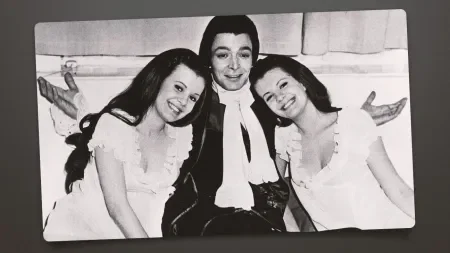
Damien Thomas
Birthday:
10 Apr, 1942
Date of Death:
17 Apr, 2025
Cause of death:
Progressive supranuclear palsy
Nationality:
British
Famous As:
British Actor
Age at the time of death:
83
Early Life
Damien Thomas was a British character actor whose presence—whether as a haunted count, a priest, or a betrayed ex-lover—carried a kind of magnetic intensity. He never always played the hero; more often, he was the tension, the moral complexity, or the twist in the plot. Over nearly five decades, he moved from horror films to literary adaptations to sweeping miniseries, bringing a distinctive blend of gravitas, subtle eccentricity, and emotional honesty that made even supporting roles memorable. His journey is one of early loss, artistic discovery, versatility, challenges, and acting as his lifelong craft.
Damien Roy Charles Noel Court-Thomas was born on April 11, 1942, in Ismailia, Egypt. His father, a squadron leader in the Royal Air Force, was killed in action when Damien was a baby. His mother, born in Egypt of French parents, raised him thereafter, navigating the aftershocks of war, displacement, and loss while keeping alive possibility, culture, and a love for the arts.
He was educated in Britain, attending Wellington School, and later explored visual art at Dartington College before deciding to pursue acting more seriously. Even those who knew him later said that early on he carried both a quiet intensity and a readiness to observe people—traits that would serve him well in roles of moral ambiguity.
Education & Formative Influences
Thomas trained at the Royal Academy of Dramatic Art (RADA), graduating in the mid-1960s. The training grounded him not only in voice, movement, and stagecraft but also in understanding character from the inside out—how to inhabit someone who isn’t always “good” or heroic, but wounded, conflicted, or compromised. Early repertory theatre kept him sharp: on stage, one night the romantic lead, the next the antagonist, always learning.
Before RADA, his art studies and his time absorbing visual culture—light, shadow, shape—left their imprint on his acting. He was someone who noticed, who listened, who balanced technical discipline with emotional truth.
Career Journey
Damien Thomas’s acting career falls naturally into phases: early film and horror work, establishing himself as a versatile character actor, peak television/miniseries roles, and later years marked by both continuity and slower pace.
Phase One: Horror and Film Beginnings
His screen debut came in the late 1960s, among anthology-series episodes and small movie parts. One of the earliest moments that stuck with people was in Twins of Evil (1971), a gothic horror film in which he played Count Karnstein—a charming, dangerous vampire aristocrat. That role made him both “Hammer’s master of the macabre” in some eyes, and typecast in the kind of atmospheric villainy where physicality and presence are as important as dialogue.
Alongside that, he took roles in period films like Henry VIII and His Six Wives, Julius Caesar, and adventure/fantasy films—roles that required adaptability. Sometimes he was an aristocrat, sometimes a servant, sometimes a figure whose background was foreign, whose accent or ethics were complicated.
Phase Two: The Character Actor and Television
In the 1970s and 1980s, Thomas expanded more into television and miniseries. His role as Father Martin Alvito in Shōgun (1980) showed that he could hold complex emotional weight in a big international production. In Jane Eyre (1983), he played Richard Mason—a character who embodies betrayal and tension in that story’s Gothic romance. Other credits include Beau Geste, Blake’s 7, House of Cards, Agatha Christie’s Poirot, and Tenko—each role different in tone, geography, moral coloration.
Though he never always carried the lead, he was the glue in many ensemble stories: the person whose turn in a scene shifted stakes, whose look in a corridor signaled more than words.
Phase Three: Challenges, Reflection & Later Career
After some of his most noted successes, Thomas experienced what he described as difficult years—roles stopping short of promise, projects that didn’t break through as hoped. He kept working, though, steadily, across TV, film, stage. In later years, though his appearances became fewer, they remained purposeful. He turned back to theatre occasionally, took roles that challenged him, and maintained his professionalism and constancy even when public acclaim ebbed.
Health became a factor in his final years—he suffered from progressive supranuclear palsy—and that curtailed activity. Yet even then, the echoes of his performances, the heritage of those memorable characters, continued to resonate with colleagues, fans, and the acting community.
Personal Life
Damien Thomas was married three times. His first marriage was in 1968; his second in 1980, through which he had a son, Dominic; and in 2012 he married his third wife, Julia Sargent, with whom he had two daughters, Maud and Phoebe. He was also step-parent to several children through these unions.
Despite his public visibility in many roles, those who knew him speak of him as quietly generous, contemplative, someone who loved literature, art, and what storytelling could do. He never lost a sense of observation—or of humility. Even when embodying countly arrogance or villainy, he was grounded off-camera by family, friendships, and an awareness that each role, no matter how small, was an opportunity to explore something human.
Legacy
Damien Thomas died on April 18, 2025 at the age of 83, having left behind a rich body of work that spans horror, fantasy, historical drama, literary adaptation, and television. His legacy is one of character rather than celebrity: of roles that linger in memory, not because they were always central, but because he made them matter.
He will be remembered foremost for Twins of Evil, Shōgun, Jane Eyre, and similar works—his ability to shift between genres, to take on parts that demanded moral complexity, and to remain believable even in flamboyant or supernatural settings.
He helped define what a “character actor” could be: someone who adds texture, tension, and authenticity, who can elevate story without always being in the spotlight.
His steadiness—persisting through the ups and downs of Hollywood and British television, through typecasting, through health—speaks of dedication to craft.
Conclusion
Damien Thomas’s life was not a classic star arc—he was rarely the marquee name, but he was often the reason people remembered a scene, a moment, a shiver of atmosphere. From the haunted castles of Hammer horror to the cruelty and romance of literary dramas, from the complexities of priests, ex-lovers, betrayed men, to the supernatural, he gave each role his full weight. His legacy is of intensity, versatility, and presence. Damien Thomas showed that acting is as much about what you bring quietly as what you display boldly—and that character, in all its shades, becomes unforgettable when it’s lived honestly.
Profile Snapshot
Name:
Damien Roy Charles Noel Court-Thomas
Popular Name:
Damien Thomas
Gender:
Male
Cause of Death:
Progressive supranuclear palsy
Spouse:
Jocelyne Sbath
Françoise Alaoui-Drai
Julia Sargent
Place of Birth:
Ismailia, Egypt
Place of Death:
Wiltshire, England
Occupation / Profession:
British Actor
Personality Type
Consul: Damien Thomas appeared to be a thoughtful and disciplined actor with a strong inner vision, capable of inhabiting both grand dramatic and morally complex roles, combining serious artistry with a calm confidence in his craft.
Damien Roy Charles Noel Court-Thomas's Interesting Facts
Damien Thomas was a British actor best known for his roles in gothic horror films and television dramas.
He often appeared in Hammer Horror productions during the 1970s, which gave him cult status among fans of classic horror.
Beyond horror, he had a long television career with roles in series such as Shōgun, Jane Eyre, and Doctors.
His distinctive presence and versatility made him a familiar face on British TV for decades.
External Links
Additional Links
Latest Profiles
People also viewed

Tony Slattery
Born09 Nov, 1959
Died14 Jan, 2025
NationalityBritish
Age at time of death65