Real Celebrities Never Die!
OR
Search For Past Celebrities Whose Birthday You Share
Died Age: 91

www.nytimes.com
Giorgio Armani
Birthday:
10 Jul, 1934
Date of Death:
03 Sep, 2025
Cause of death:
Natural Causes
Nationality:
Italian
Famous As:
Italian fashion designer
Age at the time of death:
91
Giorgio Armani's Quote's

“I must always try to do better. Because perfectionism, and the need to always have new goals and achieve them, is a state of mind that brings profound meaning to life”
Giorgio Armani
🔗 deadcelebrityhub.com
Early Life
Giorgio Armani was a visionary who transformed the fashion world by proving that elegance could be both understated and powerful. With his signature soft tailoring and minimalist approach, he redefined the way people dressed—blurring lines between comfort and sophistication, and reshaping what “power dressing” meant for men and women alike. Armani was not just a designer of clothes; he was an architect of modern style.
Born on July 11, 1934, in Piacenza, Italy, Armani grew up in modest surroundings during a time of war and scarcity. His father worked in logistics, while his mother nurtured a close-knit family that included Giorgio, his older brother, and younger sister. As a child, he experienced both the resilience required to endure wartime Italy and the sense of discipline that would later define his work.
Originally, Armani envisioned a practical path for himself—he began studying medicine at university. But his heart was not in it. Unmoved by the clinical world, and unable to bear the sight of blood, he soon left that pursuit behind. After a brief stint in military service, he discovered a different calling altogether: the world of style, fabric, and design.
Education & Formative Influences
Armani’s education in fashion did not come from classrooms but from experience. He began working as a window dresser in a Milan department store, where he observed how people reacted to displays and how clothing could shape identity. That job sparked his fascination with the dialogue between garment and wearer.
Soon after, he entered the world of tailoring, learning under established designers and immersing himself in fabrics, cuts, and construction. From those early years, he took away a lifelong lesson: clothing should never be stiff or overdesigned. Instead, it should move with the body, adapting to the person rather than forcing the person to adapt to it.
Career Journey
The Apprenticeship Years
Armani’s first major step into design came when he began creating menswear for established houses. He absorbed everything—precision tailoring, fabric choices, the traditions of Italian craftsmanship—while quietly imagining how he might soften and simplify those conventions.
Launching His Own Label
In 1975, with the encouragement and partnership of Sergio Galeotti, Armani launched his own company. From the start, his collections stood apart. His jackets had softer shoulders, his palettes leaned toward earthy neutrals, and his designs spoke of elegance without ostentation. For men, his clothes offered freedom and subtle confidence; for women, they offered authority without rigidity.
One pivotal cultural moment came in the early 1980s when Armani’s designs appeared on the silver screen. Suddenly, his fluid tailoring was not just admired in fashion circles—it became part of the global imagination, forever linked with modern cool.
Global Expansion
By the late 1980s and 1990s, Armani’s vision had expanded far beyond clothing. He introduced multiple lines—Emporio Armani, Armani Exchange, and Armani Privé—each catering to different markets while staying true to his aesthetic. He ventured into fragrances, accessories, interiors, and even hospitality, creating restaurants and hotels under the Armani name. The brand became synonymous not just with fashion, but with a way of life.
Later Years
Armani continued to design into his later decades, remaining deeply involved in the creative direction of his company. Unlike many of his contemporaries, he kept his business private, refusing to sell out to conglomerates. In his view, control was essential to preserving integrity. Even in his 80s and 90s, he personally oversaw collections, determined that the essence of Armani remain undiluted.
Personal Life
Though intensely private, Armani’s personal life deeply shaped his journey. His closest partner, Sergio Galeotti, was both the co-founder of his business and the love of his life. Galeotti’s death in the mid-1980s was a profound loss, but Armani honored his memory by carrying forward the empire they had built together.
Armani never married and had no children, but he surrounded himself with trusted family members and longtime collaborators. Known for his discipline—early mornings, long hours, and meticulous attention to detail—he lived as he designed: with simplicity, order, and elegance. Yet he was not without warmth; those who knew him spoke of his dry wit, loyalty, and quiet generosity.
Legacy
When Giorgio Armani passed away in September 2025, the fashion world lost more than a designer—it lost one of its great architects. Armani’s legacy is immense:
Redefining tailoring: He softened jackets, removed unnecessary structure, and created clothing that allowed people to move and live with ease.
Empowering women: His suits for women offered authority without harshness, helping shape the aesthetic of female leadership in the late 20th century.
Building an empire: Armani was among the first designers to expand into lifestyle branding, proving that a fashion house could extend into fragrance, interiors, and hospitality without losing its identity.
Remaining true to vision: Unlike many peers, he maintained independence, keeping his company private and fiercely protective of its values.
Conclusion
Giorgio Armani’s story is one of resilience, discipline, and uncompromising vision. From a childhood shaped by wartime hardship to becoming one of the most influential designers of the 20th and 21st centuries, he redefined what elegance meant. He showed the world that luxury need not scream—it could whisper, softly but unmistakably. Armani leaves behind more than garments; he leaves a philosophy of style that values authenticity, confidence, and simplicity.
He will forever be remembered as the man who made elegance timeless.
Profile Snapshot
Name:
Giorgio Armani
Popular Name:
Giorgio Armani
Gender:
Male
Cause of Death:
Natural Causes
Spouse:
Unmarried
Place of Birth:
Piacenza, Kingdom of Italy
Place of Death:
Milan, Italy
Occupation / Profession:
Italian fashion designer
Personality Type
Entrepreneur: Giorgio Armani was a visionary yet disciplined creative leader, driven by a quest for enduring elegance, consistency, and authenticity, who preferred subtle power and refined control over flash and trends
Giorgio Armani's Interesting Facts
Giorgio Armani started his career as a window dresser and later worked as a designer for Nino Cerruti before launching his own label.
He is credited with pioneering relaxed, unstructured suits for men in the 1980s, transforming business fashion.
Armani became the first designer to dress Hollywood actors on the red carpet, including in films like American Gigolo.
Despite his global fashion empire, Armani is known for maintaining a very private and disciplined personal life.
Achievements & Awards
Giorgio Armani has received numerous prestigious awards throughout his career. He was recognized with the Neiman Marcus Award in 1979 and later named Best International Designer by the CFDA in 1983, followed by their Lifetime Achievement Award in 1987. Over the years, he was also honored as an Officer of the Legion of Honour in France, received Italy’s Compasso d’Oro Career Award in 2014, the Outstanding Achievement Award at The Fashion Awards in 2019, and in 2021, was bestowed the Knight Grand Cross of the Order of Merit of the Italian Republic.
External Links
Additional Links
Latest Profiles
People also viewed
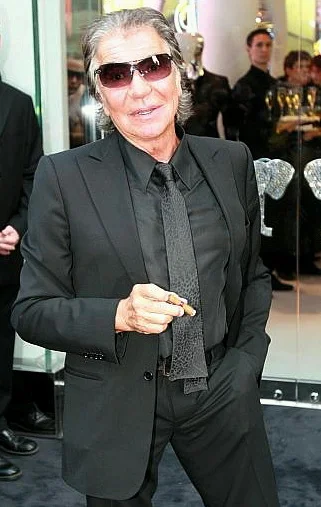
Roberto Cavalli
Born15 Nov, 1940
Died12 Apr, 2024
NationalityItalian
Age at time of death83