Real Celebrities Never Die!
OR
Search For Past Celebrities Whose Birthday You Share
Died Age: 88
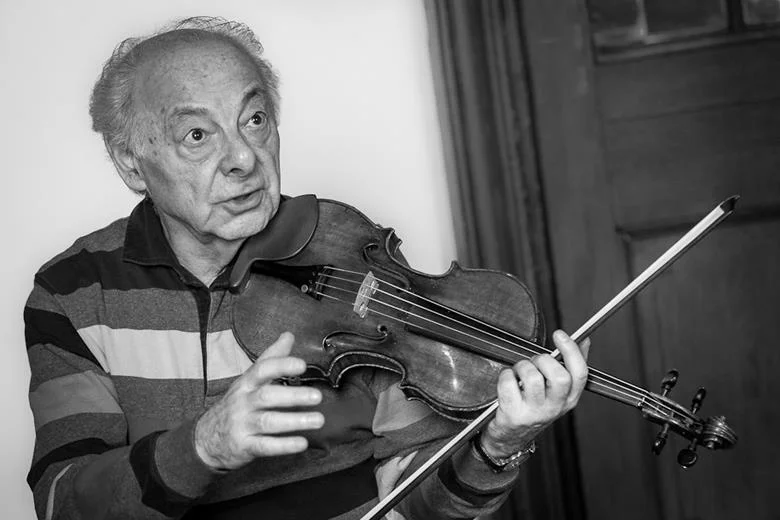
thelistenersclub.com
György Pauk
Birthday:
26 Oct, 1936
Date of Death:
18 Nov, 2024
Cause of death:
Complications from a fall
Nationality:
Hungarian
Famous As:
Chamber musician
Age at the time of death:
88
György Pauk's Quote's

“When my solo career was fulfilled … I still practice sometimes, I need to move my fingers even if I do not play in front of audiences. … You cannot let go of music.”
György Pauk
🔗 deadcelebrityhub.com
Early Life: Born into Silence and Sound
In the rarefied world of classical music, where precision meets passion, few violinists have wielded the bow with as much elegance, intelligence, and soul as György Pauk. Often described as a musician’s musician, Pauk has not only graced the world’s most prestigious stages, but also nurtured generations of violinists through his devotion to performance and pedagogy.
His journey—from a childhood shadowed by war and oppression in Hungary to becoming an international virtuoso and beloved teacher—is not merely a story of technical mastery. It is a story of resilience, memory, and an unshakable belief in the power of music to preserve cultural identity and speak across time.
György Pauk was born on October 26, 1936, in Budapest, Hungary, a city with music in its bones and tragedy in its history. He grew up during a time of immense upheaval—witnessing the rise of fascism, the Holocaust, and the post-war Soviet occupation. As a Jewish child during World War II, his early years were marked by fear and displacement.
But amidst this darkness, music offered a sanctuary. He began violin lessons at the age of five, quickly revealing an instinctive affinity for the instrument. His prodigious talent earned him a place at the Franz Liszt Academy of Music, where he studied under the legendary Ede Zathureczky, himself a student of Jenő Hubay, linking Pauk to the grand Hungarian violin tradition.
Trivia: Pauk shared classrooms with other soon-to-be greats like György Kurtág and György Ligeti, creating an environment crackling with future genius.
Education: Forged in the Hungarian Tradition
At the Franz Liszt Academy, Pauk absorbed the essence of the Hungarian school—a violin tradition steeped in lyricism, fire, and stylistic authenticity. He also studied with Zoltán Kodály, whose philosophies about Hungarian folk music deeply influenced Pauk’s musical voice.
More than scales and études, Pauk’s education was about transmitting a worldview through sound—a sense of phrasing, of breathing with the music. He learned not just how to play, but how to speak through the violin, to tell a story with every phrase.
In 1956, after the Hungarian Revolution was brutally crushed, Pauk left the country—a painful choice that marked the beginning of a new life in exile.
Career Journey
Phase One: Arrival and Ascent
After fleeing Hungary, Pauk settled in London, where he quickly made a name for himself in the competitive classical scene. He won several major international competitions, including the Paganini Competition in Genoa and the Jacques Thibaud Competition in Paris.
Soon, he was performing as a soloist with top orchestras—the Berlin Philharmonic, the London Symphony Orchestra, the Chicago Symphony—and working with conductors such as Sir Georg Solti, Claudio Abbado, and Pierre Boulez. His interpretations, particularly of Brahms, Bartók, and Beethoven, were praised for their emotional depth and architectural clarity.
Fun Fact: Pauk often performed on the Massart Stradivarius, made in 1714, an instrument once owned by the legendary Eugène Ysaÿe.
Phase Two: Chamber Music and Collaboration
Pauk was also an ardent chamber musician. He formed a celebrated trio with pianist Peter Frankl and cellist Ralph Kirshbaum, performing across Europe, North America, and Asia. Their ensemble work was praised for its transparency and deep musical conversation.
This phase of his career revealed another side of Pauk—not just a brilliant soloist, but a generous listener and collaborator, attuned to the nuances of shared musical space.
Phase Three: Teaching and Legacy Building
In 1987, György Pauk became Professor of Violin at the Royal Academy of Music in London, a role that would define his later years. Through his meticulous, often demanding instruction, he became one of the most respected violin pedagogues of his generation.
His students have gone on to international careers, and his masterclasses—often recorded and studied worldwide—continue to shape the next wave of classical talent. Whether in London, Tokyo, or Tel Aviv, Pauk’s influence can be heard in bow strokes and phrasing that echo his own exacting standards.
Personal Life: Exile, Identity, and Quiet Devotion
Though reserved by nature, Pauk’s life has been shaped by profound themes—loss, exile, and cultural continuity. He has spoken candidly about the trauma of the Holocaust and the burden of losing so many family members during the war.
Yet he has never let grief define him. Instead, he has channeled memory into music, preserving not just technique but the emotional DNA of a vanished world.
He has lived in London for decades, but remains unmistakably Hungarian—in sound, spirit, and sensibility. He speaks often of Bartók as a spiritual compass and returns frequently to the music of Kodály, Dohnányi, and Enescu.
Trivia: Pauk published his memoir, “Playing from the Heart”, in which he reflects not just on his career but on the power of memory, identity, and the violin as a voice for the soul.
Legacy: A Living Link to the Golden Age
György Pauk represents a rare lineage—a direct line to 19th-century violin tradition, carried through the storms of the 20th century and preserved into the 21st. He is one of the last living links to a golden age of violin playing, yet he has never rested on nostalgia.
Instead, he has chosen to pass on the flame—to teach, to mentor, and to insist on excellence in an era often distracted by speed and showmanship. His interpretations of Bartók and Brahms are considered reference points. His students carry forward not just his techniques, but his musical conscience.
In an age of rapid change, György Pauk is a reminder of music’s deeper purpose: to remember, to endure, and to connect. With every note, he speaks not only as a violinist but as a witness to history, a keeper of tradition, and a mentor to the future.
Profile Snapshot
Name:
György Pauk
Popular Name:
György Pauk
Gender:
Male
Cause of Death:
Complications from a fall
Spouse:
Unknown
Place of Birth:
Budapest, Kingdom of Hungary
Place of Death:
Budapest, Hungary
Occupation / Profession:
Chamber musician
Hungarian violinist
Music pedagogue.
Personality Type
Logistician Practical and fact-minded individuals, whose reliability cannot be doubted. György Pauk is a disciplined, reliable, and detail-oriented master of his craft, whose structured approach and dedication to excellence have shaped generations of musicians.
György Pauk's Interesting Facts
Besides performing, he is also a dedicated teacher who has influenced many young violinists around the world.
György Pauk is a Hungarian violinist renowned for his expressive playing and long-standing international career.
He studied at the Franz Liszt Academy of Music in Budapest under the guidance of famous violinists.
Pauk has premiered numerous contemporary works, actively contributing to modern violin repertoire.
Achievements & Awards
György Pauk is an internationally celebrated Hungarian violinist known for his distinguished career as a soloist and chamber musician.
He has received numerous prestigious awards, including the Bartók–Pásztory Prize and the Gold Medal of the Royal Philharmonic Society, recognizing his exceptional contribution to music.
His influence extends into education as well, earning acclaim for his work nurturing the next generation of violinists.
External Links