Real Celebrities Never Die!
OR
Search For Past Celebrities Whose Birthday You Share
Died Age: 39
britannica.com
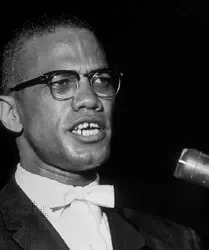
Malcolm X
Birthday:
19 May, 1925
Date of Death:
21 Feb, 1965
Cause of death:
Assassination by gunshots
Nationality:
American
Famous As:
African American revolutionary
Age at the time of death:
39
Malcolm Little's Quote's
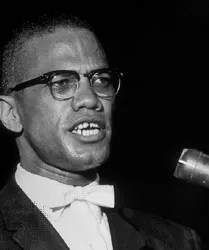
“I believe in the brotherhood of man, all men, but I don't believe in brotherhood with anybody who doesn't want brotherhood with me. I believe in treating people right, but I'm not going to waste my time trying to treat somebody right who doesn't know how to return the treatment.”
Malcolm Little
🔗 deadcelebrityhub.com
Early Life: Shadows in Lansing
Fierce, unyielding, and incandescent with conviction, Malcolm X was a man who refused to be silent. Where others asked politely, he demanded. Where some offered the dream, he brought the mirror. A former hustler turned revolutionary, Malcolm’s life was a thunderstorm of transformation—violent in its past, electric in its clarity, and unforgettable in its impact. To millions, he gave voice to rage, dignity to identity, and power to the unheard. His words were sharp as razors, his vision uncompromising, and his legacy immortal.
Born Malcolm Little on May 19, 1925, in Omaha, Nebraska, he came into a world already stained by violence and racial hatred. His father, Earl Little, was a Baptist preacher and outspoken follower of Marcus Garvey. For this, he was targeted by white supremacists, and when Malcolm was just six, his father was found dead—his body mutilated and left on streetcar tracks. Official reports called it an accident. His family never believed that.
After his father's death, Malcolm’s mother, Louise, struggled with grief and poverty. Eventually institutionalized, she was separated from her children. Malcolm was shuffled through foster homes in Lansing, Michigan, surrounded by a society that told him his dreams were too big for his skin.
Trivia: A white teacher once told Malcolm he could never be a lawyer—“a carpenter might be more realistic.” Malcolm never forgot the moment. It became a spark that would later ignite his rebellion.
Education: Lessons from the Street
Though intelligent and articulate, Malcolm dropped out of school at 15. He drifted to Boston and later Harlem, where he immersed himself in a world of crime—gambling, drug dealing, racketeering. He became “Detroit Red,” sharp-dressed, smooth-talking, and streetwise.
In 1946, he was arrested for burglary and sentenced to 10 years in prison. But behind bars, he underwent the most profound transformation of his life. He devoured books, debated philosophy, studied religion. And through letters from his siblings, he discovered the Nation of Islam and its leader, Elijah Muhammad.
By the time he left prison in 1952, Malcolm Little was gone. Malcolm X was born—the “X” symbolizing the stolen name and identity of his African ancestors.
Career Journey: The Flame of a Movement
The Rise of a Revolutionary Voice
In the Nation of Islam, Malcolm rose like a meteor. With his towering presence, firebrand oratory, and intellect, he became the group’s most dynamic minister and recruiter. From small mosques to television debates, Malcolm electrified audiences with a message of Black self-sufficiency, pride, and resistance.
He was uncompromising. He criticized the civil rights movement’s nonviolent tactics, famously declaring: “You don’t get freedom peacefully. You get it by spilling blood.” To some, he was dangerous. To others, he was finally telling the truth.
Trivia: Malcolm once debated at Oxford University, leaving the crowd stunned and many white intellectuals shaken by the clarity and force of his arguments.
Break with the Nation: A Turning Point
By 1964, cracks began to form. Disillusioned by Elijah Muhammad’s personal scandals and internal politics, Malcolm left the Nation of Islam. His departure was seismic—not just politically, but spiritually.
He founded Muslim Mosque, Inc. and made a pilgrimage to Mecca, where he saw Muslims of all races worshipping side by side. It shattered his earlier views on race and transformed his philosophy.
He returned to the U.S. with a new name: El-Hajj Malik El-Shabazz—and a new vision. No longer did he preach Black separatism. Instead, he spoke of global human rights, unity among oppressed peoples, and a coalition beyond color.
This evolution marked the most powerful stage of his life—and sealed his fate.
Personal Life: The Private Man Behind the Public Flame
Away from the stage, Malcolm was a devoted family man. He married Betty Shabazz in 1958, and together they had six daughters. In rare moments of quiet, he was thoughtful, warm, even playful with his children. But the threats were constant—FBI surveillance, Nation of Islam hostility, and death threats that mounted by the day.
Still, he pressed on, driven by a sense of duty that outweighed his fear.
Legacy: A Light That Burned Brightest at the End
On February 21, 1965, Malcolm X was assassinated in Harlem while giving a speech at the Audubon Ballroom. He was just 39 years old.
Three men from the Nation of Islam were convicted, though conspiracy theories—and evidence—suggest deeper involvement, possibly including government surveillance programs like COINTELPRO.
But death could not silence Malcolm’s words. His autobiography, co-written with Alex Haley, became a bestseller and a sacred text of American thought. His speeches are still studied, sampled, and quoted across generations.
Where Martin Luther King Jr. spoke of dreams, Malcolm spoke of reality. Where King offered the balm, Malcolm gave the fire. Both were necessary. Together, they defined the arc of a movement.
Trivia: Malcolm X’s funeral drew thousands, including celebrities, activists, and ordinary citizens. Actor Ossie Davis delivered the eulogy, calling him “our shining Black prince.”
Conclusion: More Than a Martyr
Malcolm X was more than the anger he is often reduced to. He was a man of constant growth—intellectually, spiritually, politically. He changed his views when truth demanded it, and he paid with his life for the courage to evolve.
His legacy is not simply that of a militant, but of a man who taught a people to love themselves fiercely and unapologetically. He made America confront its mirror, and in doing so, made it better—even if it still hasn’t caught up to his vision.
He didn’t just speak for his time. He speaks for ours.
Profile Snapshot
Name:
Malcolm Little
Popular Name:
Malcolm X
Gender:
Male
Cause of Death:
Assassination by gunshots
Spouse:
Betty Shabazz
Place of Birth:
Omaha, Nebraska, U.S.
Place of Death:
Manhattan, New York City, U.S.
Occupation / Profession:
African American revolutionary
Human rights activist
Muslim minister
Personality Type
Commander: Malcolm X was a bold, visionary leader with a fierce determination to challenge the status quo, driven by a deep commitment to justice, equality, and self-improvement, all while strategically leading others toward societal change.
Malcolm Little's Interesting Facts
After a transformative pilgrimage to Mecca in 1964, Malcolm X’s views evolved, and he began advocating for global human rights and unity between races.
Born Malcolm Little, he adopted the name “Malcolm X” to symbolize his lost African heritage, with “X” representing the unknown.
Malcolm X was a prominent African American civil rights leader who advocated for black empowerment, self-defense, and racial justice during the 1960s.
Tragically, he was assassinated in 1965 while speaking at a rally in New York City, but his legacy continues to inspire movements for racial equality and social justice.
Achievements & Awards
His legacy is commemorated through schools, streets, and cultural tributes, and his autobiography remains a landmark work in American literature and activism.
While Malcolm X didn’t receive formal awards during his lifetime, he is widely honored posthumously for his powerful role in the civil rights movement.