Real Celebrities Never Die!
OR
Search For Past Celebrities Whose Birthday You Share
Died Age: 76
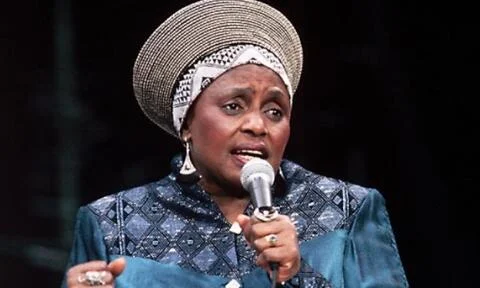
sahistory.org.za
Miriam Makeba
Birthday:
04 Mar, 1932
Date of Death:
08 Sep, 2008
Cause of death:
Heart Attack
Nationality:
South African
Famous As:
Actress
Age at the time of death:
76
Zenzile Miriam Makeba's Quote's

“I kept my culture. I kept the music of my roots. Through my music I became this voice and image of Africa, and the people, without even realizing.”
Zenzile Miriam Makeba
🔗 deadcelebrityhub.com
Early Life: Roots in Rhythm and Resistance
Miriam Makeba didn’t just sing—she soared. With a voice as rich as Africa’s soil and as piercing as injustice itself, she captivated audiences around the globe, not only with her music but with her unshakable moral courage. Known as “Mama Africa,” she was more than a Grammy-winning artist; she was a defiant ambassador of Black dignity, a living song of resistance. Her life was a symphony of beauty and heartbreak, silenced too often by exile and loss, but always returning to its chorus: freedom.
Miriam Makeba was born Zenzile Miriam Makeba on March 4, 1932, in Prospect Township near Johannesburg, South Africa, during the height of segregation under colonial rule. Her mother, a domestic worker and traditional healer, was jailed for six months shortly after Miriam’s birth for making and selling umqombothi—traditional African beer. It was Miriam’s first taste of a system that criminalized Black life in its smallest expressions.
Raised in Sophiatown, a lively, multiracial Johannesburg neighborhood pulsing with jazz and township culture, Miriam was surrounded by the rhythm and poetry of African identity. But this creative haven was later demolished by the apartheid regime—another symbol of a youth shaped by joy and destruction in equal measure.
Trivia: She sang in Xhosa and Zulu before she ever sang in English—and remained one of the few global stars to perform exclusively in African languages at the height of her fame.
Education: School of Song and Struggle
Makeba's formal schooling was modest—constrained by the limitations imposed on Black South Africans under apartheid—but her musical education was deeply organic. She began singing in her church choir at an early age and soon realized that her voice could carry more than melody; it could carry history.
Her earliest performances came through family and community events. She joined the Manhattan Brothers in the 1950s and later formed her own group, The Skylarks, blending jazz, traditional African music, and American doo-wop into a sound that was unmistakably her own.
Career Journey: From Local Songstress to Global Icon
Early Career: The Rise of a Cultural Rebel
Makeba’s breakthrough came in 1959, when she starred in the anti-apartheid film Come Back, Africa, which premiered at the Venice Film Festival. Her performance was so powerful that international doors swung open. She traveled to the U.S., where she was introduced to Harry Belafonte—himself a prominent activist—who became her mentor and collaborator.
In 1960, while she was abroad, the South African government revoked her passport, effectively exiling her for speaking out against apartheid. She was just 28.
International Stardom and Political Defiance
Makeba quickly rose to prominence in the U.S. Her 1967 hit “Pata Pata” became a global sensation, and she performed at sold-out venues from Carnegie Hall to Paris. But Makeba was no pop star detached from politics—she was, at her core, a protest singer.
She testified before the United Nations in 1963, condemning apartheid and calling attention to South Africa’s systemic brutality. Her testimony led the South African government to ban all of her music.
Trivia: She was the first African artist to win a Grammy Award, sharing it with Harry Belafonte in 1966 for their album An Evening with Belafonte/Makeba, which featured songs highlighting the oppression of Black South Africans.
Later Career: Love, Loss, and Legacy
Her life was marred by personal pain. She married civil rights activist Stokely Carmichael in 1968, leading to political backlash in the U.S. and prompting them to move to Guinea, where she lived in exile for over a decade. There, she served as Guinea’s official delegate to the United Nations, speaking powerfully on African issues.
Though largely absent from the Western spotlight in the '70s and '80s, she continued to tour, perform, and support liberation struggles worldwide—including the fight against colonial rule in Mozambique and Angola.
In 1990, after 31 years of exile, Makeba finally returned home—invited by none other than Nelson Mandela, newly freed from prison. Her homecoming was a moment of national catharsis.
Personal Life: The Voice Behind the Woman
Makeba’s life was one of both passion and perseverance. She suffered multiple miscarriages, battled cervical cancer, and endured government harassment, loss of citizenship, and professional blacklisting.
Her only daughter, Bongi Makeba, died in 1985—a devastating blow that left a wound she never fully healed. Yet through all of it, she kept singing.
Those close to her described her as deeply spiritual, reserved, yet fiercely committed to justice. She never saw herself as a political figure—just as someone who could not stay silent.
Legacy: The Soul of a Continent
Miriam Makeba died in 2008, collapsing on stage in Italy after performing “Pata Pata” at a benefit concert. It was, in many ways, a fitting end: her voice literally gave out in service of a cause.
Her music and activism paved the way for generations of African artists to claim the global stage not just as entertainers, but as truth-tellers. From Angelique Kidjo to Beyoncé, her fingerprints are everywhere.
In 2017, the African Union declared a day in her honor. Streets, schools, and music festivals bear her name across the continent. She remains not just a symbol of protest, but of grace—of how culture can become revolution.
Trivia: She held passports from nine countries and was banned from more than ten during her lifetime.
Conclusion: A Voice That Freed a People
Miriam Makeba was more than a singer. She was a vessel for a continent’s pain, hope, and pride. She turned music into a weapon, exile into influence, and loss into a lasting legacy. Long before hashtags and global movements, she showed the world what it meant to be unflinchingly Black, boldly African, and beautifully human.
She didn’t just sing of freedom. She lived it.
Profile Snapshot
Name:
Zenzile Miriam Makeba
Popular Name:
Miriam Makeba
Gender:
Female
Cause of Death:
Heart Attack
Spouse:
James Kubay
Stokely Carmichael
Place of Birth:
Johannesburg, Union of South Africa
Place of Death:
Castel Volturno, Italy
Occupation / Profession:
Actress
Civil rights activist.
Songwriter
South African singer
Personality Type
Advocate: Miriam Makeba was a deeply principled and visionary individual, driven by her passion for justice and human rights, using her powerful voice not just to entertain but to inspire and advocate for change.
Zenzile Miriam Makeba's Interesting Facts
Makeba used her music to bring attention to political issues, and she was exiled from South Africa for over 30 years due to her anti-apartheid activism.
Miriam Makeba, known as "Mama Africa," was a South African singer and civil rights activist who became internationally famous for her powerful voice and songs that spoke out against apartheid.
She performed at major international events, including the 1966 UN World Conference Against Apartheid and the 1987 Zimbabwe Independence celebration.
She was the first African woman to win a Grammy Award, which she received in 1966 for her collaboration with Harry Belafonte on the album An Evening with Belafonte/Makeba.
Achievements & Awards
Miriam Makeba, known as "Mama Africa," was a Grammy Award-winning South African singer and civil rights activist.
She received the Dag Hammarskjöld Peace Prize in 1986 and the UNESCO Grand Prix du Conseil International de la Musique in 2001 for her humanitarian work and contributions to music and anti-apartheid activism.
Latest Profiles
People also viewed

Jimi Hendrix
Born27 Nov, 1942
Died18 Sep, 1970
NationalityAmerican
Age at time of death27

Irving Berlin
Born11 May, 1888
Died22 Sep, 1989
NationalityAmerican
Age at time of death101

George Harrison
Born25 Feb, 1943
Died29 Nov, 2001
NationalityBritish
Age at time of death58

Sally Ann Howes
Born20 Jul, 1930
Died19 Dec, 2021
NationalityBritish, American
Age at time of death91

Olivia de Havilland
Born01 Jul, 1916
Died26 Jul, 2020
NationalityBritish, American
Age at time of death104
Jane Birkin
Born14 Dec, 1946
Died16 Jul, 2023
NationalityBritish, French
Age at time of death76

Lupe Vélez
Born18 Jul, 1908
Died14 Dec, 1944
NationalityMexican
Age at time of death36

Vera-Ellen
Born16 Feb, 1921
Died30 Aug, 1981
NationalityAmerican German
Age at time of death60

Phyllis Diller
Born17 Jul, 1917
Died20 Aug, 2012
NationalityAmerican
Age at time of death95

Olivia Newton-John
Born26 Sep, 1948
Died08 Aug, 2022
NationalityBritish, Australian
Age at time of death73

Mary Martin
Born01 Dec, 1913
Died03 Nov, 1990
NationalityAmerican
Age at time of death76

Jim Morrison
Born08 Dec, 1943
Died03 Jul, 1971
NationalityAmerican
Age at time of death27
Biz Markie
Born08 Apr, 1964
Died16 Jul, 2021
NationalityAmerican
Age at time of death57

Barry White
Born12 Sep, 1944
Died04 Jul, 2003
NationalityAmerican
Age at time of death58

Tina Turner
Born26 Nov, 1939
Died24 May, 2023
NationalityAfrican, American
Age at time of death83

Tawny Kitaen
Born05 Aug, 1961
Died07 May, 2021
NationalityAmerican
Age at time of death59
Adam Yauch
Born05 Aug, 1964
Died04 May, 2012
NationalityAmerican
Age at time of death47

Nina Simone
Born21 Feb, 1933
Died21 Apr, 2003
NationalityAmerican
Age at time of death70

Tammi Terrell
Born29 Apr, 1945
Died16 Mar, 1970
NationalityAmerican
Age at time of death24
Gloria Swanson
Born27 Mar, 1899
Died04 Apr, 1983
NationalityAmerican
Age at time of death84