Real Celebrities Never Die!
OR
Search For Past Celebrities Whose Birthday You Share
Died Age: 56
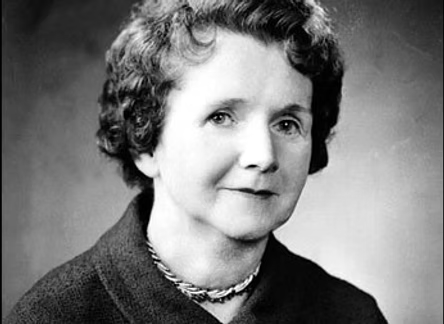
rachelcarson.org
Rachel Carson
Birthday:
27 May, 1907
Date of Death:
14 Apr, 1964
Cause of death:
Cancer
Nationality:
American
Famous As:
American marine biologist
Age at the time of death:
56
Rachel Louise Carson's Quote's
“Over increasingly large areas of the United States, spring now comes unheralded by the return of the birds, and the early mornings are strangely silent where once they were filled with the beauty of bird song.”
Rachel Louise Carson
🔗 deadcelebrityhub.com
Early Life: Streams, Stories, and a Lifelong Curiosity
Before the modern environmental movement had a name, it had a quiet yet unwavering voice—Rachel Carson. A marine biologist by training and a writer by passion, Carson possessed the rare ability to turn scientific observation into poetic revelation. With grace, grit, and scientific rigor, she challenged an era intoxicated with technological triumph, sounding the alarm on ecological devastation when few dared to listen. In doing so, she changed not only laws and policies, but hearts and minds.
Rachel Louise Carson was born on May 27, 1907, in the rural town of Springdale, Pennsylvania, perched above the Allegheny River. Her upbringing was steeped in the natural world—long walks in the woods, birdwatching with her mother, and endless hours reading by lamplight. Her mother, Maria Carson, recognized Rachel’s talents early and nurtured them with books, encouragement, and a deep reverence for nature.
She published her first story at age 10 in a children’s magazine. Even then, her writing reflected a fascination with the unseen rhythms of the natural world—an interest that would blossom into a career.
Trivia: Rachel originally dreamed of becoming a writer of fiction, even enrolling in college as an English major before switching to biology.
Education: A Scientist with a Poet’s Heart
Carson studied at the Pennsylvania College for Women (now Chatham University), where she shifted from English to biology after being captivated by a zoology course. She earned her master’s degree in zoology from Johns Hopkins University in 1932—a rare achievement for a woman in science at the time.
Though she briefly pursued doctoral studies, the Great Depression forced her to leave school and support her family. Yet her dual fluency in science and language made her a natural fit for government science writing—and later, a bestselling author who made biology beautiful.
Career Journey: From Government Biologist to Environmental Icon
Early Career: Words for a Watery World
Carson began her professional career in the U.S. Bureau of Fisheries, writing radio scripts and informational brochures during the 1930s. Her clarity and lyricism stood out—she had a knack for transforming dry facts into elegant prose. She eventually rose to become editor-in-chief of all publications for the U.S. Fish and Wildlife Service.
But her true passion lay beyond bureaucracy. She published her first book, Under the Sea-Wind, in 1941, followed by The Sea Around Us in 1951—a landmark bestseller that earned her the National Book Award and made oceanography a topic of public fascination. These books weren’t just scientific treatises; they were love letters to the sea, rich with metaphor and wonder.
Turning Point: Silent Spring and the Storm It Stirred
In 1962, Carson published Silent Spring, a searing indictment of chemical pesticides—particularly DDT—and their ripple effects on ecosystems. The book opened with a haunting fable of a town where birds no longer sang, a world muted by toxic intervention.
Carson meticulously documented how pesticides entered the food chain, harming wildlife and threatening human health. The backlash was swift and brutal. She was called “hysterical,” “emotional,” and accused of being anti-science by chemical companies and some government officials.
But Carson stood firm. She testified before Congress, calmly but forcefully calling for greater regulation and ecological responsibility. Her voice—gentle, precise, unwavering—cut through the noise.
Trivia: Silent Spring was serialized in The New Yorker and later credited by many—including Al Gore—as the catalyst for the modern environmental movement.
Personal Life: Private Strength and Quiet Resolve
Rachel Carson never married and lived much of her life caring for family members, including her mother, her sister, and later her young grandnephew Roger, whom she adopted and raised. She was known to be shy but deeply loyal, with a close circle of female friends and a deep affection for animals and poetry.
Even while battling breast cancer—diagnosed during the writing of Silent Spring—she remained focused on her mission, refusing to let illness slow her work. Her personal integrity, humility, and resilience were as enduring as her scientific brilliance.
Legacy: The Mother of Environmentalism
Rachel Carson died on April 14, 1964, at the age of 56, just two years after Silent Spring was published. But her impact was just beginning.
Her book led directly to the eventual ban of DDT in the United States and the creation of the Environmental Protection Agency in 1970. She is often credited as the spiritual mother of Earth Day and a guiding light for environmental activism around the world.
In 1980, she was posthumously awarded the Presidential Medal of Freedom, and her name lives on in nature centers, schools, and even a U.S. research vessel.
Conclusion: A Voice That Still Speaks
Rachel Carson didn’t shout. She didn’t command armies, run for office, or crave the spotlight. Instead, she wrote—with grace, with science, with soul. She believed that nature and humanity were deeply intertwined and that to harm one was to harm the other.
In an era of unchecked industrial optimism, she offered a sobering counterpoint: that progress without responsibility is peril. But she also offered hope—that through awareness, reverence, and action, we might still protect the fragile world we share.
Today, as climate change, pollution, and biodiversity loss continue to threaten our planet, her words feel more urgent than ever.
Rachel Carson gave the Earth a voice. And that voice is still echoing.
Profile Snapshot
Name:
Rachel Louise Carson
Popular Name:
Rachel Carson
Gender:
Female
Cause of Death:
Cancer
Spouse:
Unmarried
Place of Birth:
Springdale, Pennsylvania, U.S.
Place of Death:
Silver Spring, Maryland, U.S
Occupation / Profession:
American marine biologist
Conservationist
Writer
Personality Type
Advocate: Rachel Carson was a visionary, deeply introspective and principled, who used her passion for science and the natural world to inspire environmental awareness and advocate for meaningful change.
Rachel Louise Carson's Interesting Facts
Carson worked for the U.S. Fish and Wildlife Service, where she became one of the first women to hold a high-ranking scientific position in the federal government.
Despite fierce criticism, her work led to the eventual creation of the Environmental Protection Agency (EPA) in 1970, solidifying her legacy as an environmental pioneer.
Rachel Carson was a marine biologist and conservationist whose 1962 book Silent Spring helped launch the modern environmental movement.
She courageously challenged the chemical industry by exposing the dangers of pesticides like DDT, leading to widespread public awareness and policy changes.
Achievements & Awards
Her influential work Silent Spring sparked the modern environmental movement and led to major policy changes in environmental protection.
Rachel Carson received the National Book Award for her groundbreaking book The Sea Around Us and was posthumously awarded the Presidential Medal of Freedom in 1980.
External Links
Latest Profiles
People also viewed
July 11, 1899
Born11 Jul, 1899
Died01 Oct, 1985
NationalityAmerican
Age at time of death86

Dale Carnegie
Born24 Nov, 1888
Died01 Nov, 1955
NationalityAmerican
Age at time of death66
Zora Neale Hurston
Born07 Jan, 1891
Died28 Jan, 1960
NationalityAmerican
Age at time of death69

Rabindranath Tagore
Born07 May, 1861
Died08 Aug, 1941
NationalityIndian
Age at time of death80

Cicely Saunders
Born22 Jun, 1918
Died14 Jul, 2005
NationalityEnglish
Age at time of death87

Joseph Pilates
Born09 Dec, 1883
Died09 Oct, 1967
NationalityGerman
Age at time of death83

Mark Twain
Born30 Nov, 1835
Died21 Apr, 1910
NationalityAmerican
Age at time of death74

Jules Verne
Born08 Feb, 1828
Died24 Mar, 1905
NationalityFrench
Age at time of death77

Jack Welch
Born19 Nov, 1935
Died01 Mar, 2020
NationalityAmerican
Age at time of death84

Nellie Bly
Born05 May, 1864
Died27 Jan, 1922
NationalityAmerican
Age at time of death57

George Burns
Born20 Jan, 1896
Died09 Mar, 1996
NationalityAmerican
Age at time of death100

Ethan Allen
Born21 Jan, 1738
Died12 Feb, 1789
NationalityAmerican
Age at time of death51

Matthew Perry
Born19 Aug, 1969
Died28 Oct, 2023
NationalityAmerican, Canadian
Age at time of death54

Caresse Crosby
Born20 Apr, 1891
Died24 Jan, 1970
NationalityAmerican
Age at time of death78

Will Durant
Born05 Nov, 1885
Died07 Nov, 1981
NationalityAmerican
Age at time of death96

Les Dawson
Born02 Feb, 1931
Died10 Jun, 1993
NationalityBritish
Age at time of death62

James Allen
Born28 Nov, 1864
Died24 Jan, 1912
NationalityBritish
Age at time of death47

Ada Lovelace
Born10 Dec, 1815
Died27 Nov, 1852
NationalityBritish
Age at time of death36

Leo Tolstoy
Born09 Sep, 1828
Died20 Nov, 1910
NationalityRussian
Age at time of death82

George Bernard Shaw
Born26 Jul, 1856
Died02 Nov, 1950
NationalityBritish, Irish
Age at time of death94