Real Celebrities Never Die!
OR
Search For Past Celebrities Whose Birthday You Share
Died Age: 50
worldhistoryedu.com
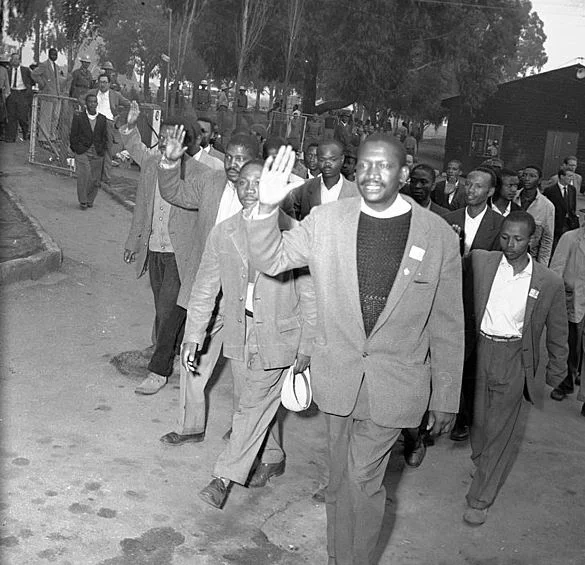
Robert Sobukwe
Birthday:
05 Dec, 1924
Date of Death:
27 Feb, 1975
Cause of death:
Lung Cancer
Nationality:
South African
Famous As:
South African anti-apartheid leader
Age at the time of death:
50
Robert Mangaliso Sobukwe's Quote's

“The wheel of progress revolves relentlessly and all the nations of the world take their turn at the field of progress. Africa will not remain behind.”
Robert Mangaliso Sobukwe
🔗 deadcelebrityhub.com
Early Life: Roots in Humility, Eyes on the Horizon
Robert Mangaliso Sobukwe was a man whose convictions could not be caged—even when his body was. A towering intellect and fiery orator, Sobukwe was a revolutionary whose belief in African self-determination reshaped South Africa’s liberation struggle. He didn't seek the limelight, yet he became a beacon; he didn’t call for violence, yet he terrified a brutal regime. Sobukwe’s story is one of principle over power, dignity over despair, and a defiance so steadfast that the apartheid government had to create a law just to keep him silent.
Robert Sobukwe was born on December 5, 1924, in Graaff-Reinet, a modest town in the Eastern Cape of South Africa. The youngest of six children in a deeply religious family, his upbringing was shaped by poverty but driven by education, discipline, and faith. His father was a laborer, his mother a domestic worker—both instilled in him a strong sense of justice and self-worth.
Sobukwe excelled at school despite the constraints of Bantu education. He had a quiet but intense nature, and even as a child, people remarked on his seriousness and command of language. The seeds of future leadership were sown in those early years among the dusty roads of the Karoo.
Education: The Making of a Radical Scholar
Sobukwe’s intellectual brilliance earned him a scholarship to Fort Hare University, a cradle of African political thought where leaders like Nelson Mandela and Oliver Tambo also studied. He initially planned to become a teacher, but political debate and the hunger for liberation pulled him in a different direction.
At Fort Hare, Sobukwe was deeply influenced by Africanist philosophy. He became known not just for his sharp mind, but for his powerful speeches—delivered in a baritone voice that could rattle walls and awaken spirits. He was drawn to the idea that Black South Africans should define their own destiny—free of white liberal guidance, paternalism, or European frameworks.
He earned degrees in native administration and languages, and later became a lecturer himself. Fluent in multiple African languages, Sobukwe believed that language was power—and that reclaiming African identity was central to true freedom.
Career Journey: From Lecturer to Liberation Leader
The Pan Africanist Break
By the 1950s, Sobukwe had become disillusioned with the direction of the African National Congress (ANC), especially its multiracial approach. He believed that South Africa’s liberation should be led by Black Africans and rooted in African nationalism. In 1959, he broke away to form the Pan Africanist Congress (PAC)—a movement grounded in the slogan “Africa for Africans.”
Sobukwe’s leadership was principled and resolute. He was no populist; he demanded discipline, clarity of purpose, and unwavering commitment. Under his direction, the PAC launched a campaign against pass laws, one of the most hated symbols of apartheid.
Sharpeville and the Sobukwe Clause
On March 21, 1960, Sobukwe led a peaceful protest against the pass laws. He and others presented themselves at police stations, asking to be arrested for not carrying their passbooks. That same day, police opened fire on a PAC protest in Sharpeville, killing 69 unarmed people. Though Sobukwe wasn’t present at the massacre, he was arrested for inciting resistance.
He was sentenced to three years in prison. But when his term ended, the apartheid government wasn’t ready to let him go. So they passed a law—later dubbed the “Sobukwe Clause”—which allowed the state to detain him indefinitely without charge or trial.
He was sent to Robben Island, where he was held in solitary confinement, separated from other political prisoners. He wasn’t allowed to speak to anyone but his guards. He spent six years there—six years of isolation for his ideas alone.
Trivia: While on Robben Island, the government feared his influence so much they denied him basic contact with fellow inmates, including Nelson Mandela.
Personal Life: A Quiet Strength Behind the Revolutionary
Robert Sobukwe married Veronica Sobukwe, a nurse and activist in her own right. Their marriage was one of quiet strength, marked by long separations due to his imprisonment and banning orders. She raised their children largely on her own, shielding them from the full weight of their father’s political burden while keeping his legacy alive.
Despite his fierce political persona, Sobukwe was introspective, gentle with friends and family, and known for his humility. He read voraciously—history, literature, philosophy—and found solace in poetry. After his release, he was banned and kept under house arrest in Kimberley, effectively silenced but never broken.
Legacy: A Flame That Still Burns
Robert Sobukwe died on February 27, 1978, of lung cancer, at just 53 years old. The apartheid regime had denied him proper medical treatment—yet even in death, he remained a powerful symbol of dignity and resistance.
Sobukwe never lived to see South Africa free, nor did he receive the global acclaim that followed many of his contemporaries. Yet among those who knew the full story, he remains a titan of the struggle—an uncompromising voice for African liberation.
Today, Sobukwe is celebrated as the conscience of the anti-apartheid movement. Schools, streets, and foundations now bear his name. His writings, speeches, and sacrifice continue to inspire generations of African thinkers and activists. In 2002, post-apartheid South Africa officially honored him with a memorial and reburial ceremony, recognizing at last the enormity of his contribution.
Conclusion: The Man Who Dared to Define Freedom
Robert Sobukwe didn’t fight for recognition—he fought for principle. In an age of compromise, he stood for purity of purpose. He believed that true liberation must begin with the liberation of the mind and that Africans must be the authors of their own destiny.
His story is not just one of political resistance, but of moral courage. In refusing to bend, in daring to speak truth in the face of oppression, Sobukwe became more than a leader—he became a symbol. And in the long arc of South African history, his voice still echoes: powerful, unbowed, and free.
Profile Snapshot
Name:
Robert Mangaliso Sobukwe
Popular Name:
Robert Sobukwe
Gender:
Male
Cause of Death:
Lung Cancer
Spouse:
Veronica Sobukwe
Place of Birth:
Graaff-Reinet, Cape Province, Union of South Africa
Place of Death:
Kimberley, Cape Province, South Africa
Occupation / Profession:
South African anti-apartheid leader
Personality Type
Advocate: Robert Sobukwe was a deeply principled, visionary, and introspective leader, driven by moral conviction and an unwavering belief in justice, equality, and African self-determination.
Robert Mangaliso Sobukwe's Interesting Facts
Despite his years of silencing and isolation, Sobukwe remains a symbol of African pride, intellectual resistance, and unwavering commitment to liberation.
He led the 1960 anti-pass law campaign, which sparked the Sharpeville Massacre and led to his arrest and years of imprisonment without trial.
Robert Sobukwe was a South African political leader and founder of the Pan Africanist Congress (PAC), known for his firm stance against apartheid and colonial domination.
The apartheid regime created the “Sobukwe Clause,” a special law allowing his continued detention even after his prison sentence had ended.
Achievements & Awards
Robert Sobukwe, a key figure in South Africa's anti-apartheid struggle, was the founding leader of the Pan Africanist Congress (PAC) and known for his powerful advocacy of African unity and liberation. While he didn’t receive formal awards during his lifetime due to political repression, he is honored posthumously through memorials, institutions, and national recognition in South Africa for his lasting impact on the fight against apartheid.