Real Celebrities Never Die!
OR
Search For Past Celebrities Whose Birthday You Share
Died Age: 23
britannica.com
Selena Quintanilla
Birthday:
16 Apr, 1971
Date of Death:
31 Mar, 1995
Cause of death:
Murder (gunshot wound)
Nationality:
American
Famous As:
American singer-songwriter.
Age at the time of death:
23
Selena Quintanilla-Pérez's Quote's

“Ever since I was a little girl I dreamed of having a big wedding, with a long white gown and a bouquet of flowers but my love for Chris was so strong. I couldn't wait any longer for us to be together as husband and wife. I couldn't even wear my nicest dress because that would've made my father suspicious.”
Selena Quintanilla-Pérez
🔗 deadcelebrityhub.com
Early Life: Born for the Stage, Raised in a Family of Dreams
Selena Quintanilla wasn’t just a singer—she was a cultural force, a bridge between worlds, and a radiant light extinguished far too soon.
With a voice that moved effortlessly between sweetness and power, and a charisma that could light up stadiums, Selena rose from humble beginnings to become the most beloved Latina artist of her time.
Her life was a symphony of passion, perseverance, and groundbreaking artistry. Though her career was cut tragically short, her legacy continues to resonate across generations, genres, and borders.
Selena Quintanilla was born on April 16, 1971, in Lake Jackson, Texas, to a Mexican-American family whose love of music ran deep. The youngest child of Abraham and Marcella Quintanilla, Selena grew up surrounded by rhythm. Her father, a former musician himself, noticed her vocal talent at an early age and began training her, forming the family band Selena y Los Dinos when she was just nine years old.
The family’s early years were marked by struggle. They often traveled in an old bus, playing weddings, fairs, and small-town festivals across Texas. At times, money was so tight the family had to sleep in the bus or rely on the kindness of relatives. But for Selena, the stage always felt like home. Whether she was singing to ten people or ten thousand, she gave everything she had.
Selena's early charm wasn’t limited to her voice—she had an infectious smile, a natural confidence, and an uncanny ability to connect with people of all ages. These qualities made her a star before she was ever signed to a label.
Education: Lessons in the Real World
Though Selena attended public school as a child, her growing popularity and travel schedule soon required homeschooling. Her life became an unconventional classroom, shaped by late-night performances, early-morning interviews, and her father’s relentless drive to see his children succeed.
Still, Selena valued education deeply. In 1989, already a rising star, she earned her high school diploma from the American School of Correspondence. Later, she began studying business administration at Pacific Western University—a testament to her discipline and her desire to eventually run her own fashion empire.
Fun fact: Despite growing up in a Spanish-speaking household, Selena didn’t speak Spanish fluently until her teens. She learned it phonetically at first, then took formal lessons so she could better connect with her fanbase—proof of her commitment to authenticity.
Career Journey: Breaking Barriers with Style and Soul
Early Career: A Rising Star in Tejano Music
Tejano music—a fusion of Mexican, European, and U.S. influences—was traditionally male-dominated when Selena entered the scene. Her presence alone was revolutionary. Her sound was crisp, modern, and genre-blending, mixing cumbia, pop, and R&B elements while staying rooted in tradition.
In 1987, at just 15, Selena won the Tejano Music Award for Female Vocalist of the Year—an honor she would take home every year for the rest of her life. By the late ’80s, she had become the most prominent female Tejano artist, signing with EMI Latin in 1989.
That same year, she released her first self-titled album with the label, establishing her as not just a regional star, but a rising force in Latin music.
Major Achievements: From Tejano Queen to Global Icon
Selena’s 1992 album Entre a Mi Mundo, featuring the hit “Como La Flor,” was a game-changer. The album went platinum and catapulted her into international stardom. Her follow-up, Amor Prohibido (1994), became one of the best-selling Latin albums in the U.S., with hits like “Bidi Bidi Bom Bom,” “No Me Queda Más,” and the title track.
She shattered barriers—not only as a woman in Tejano but as a crossover artist ready to take on the mainstream U.S. pop world. Her charisma, catchy hooks, and effortless blend of cultures made her a once-in-a-generation talent.
Selena also launched her own fashion line, Selena Etc., opening boutiques in Texas and dreaming of a fashion empire. With her signature bustiers, high-waisted pants, and bold lipstick, she became a style icon who celebrated curves, culture, and confidence.
Turning Point: On the Brink of Global Stardom
By 1995, Selena was recording her first English-language album, poised to become the next big crossover artist. Songs like “I Could Fall in Love” and “Dreaming of You” revealed a softer, sultrier pop side and hinted at a future of Grammy wins and global tours.
But that dream was cut short. On March 31, 1995, Selena was shot and killed by Yolanda Saldívar, the president of her fan club and a trusted associate, after a confrontation over embezzled funds. She was only 23.
Her death sent shockwaves through the world—especially the Latino community, which mourned not just a star, but a sister, daughter, and symbol of hope.
Personal Life: A Heart as Big as Her Voice
Offstage, Selena was known for her warmth, humility, and humor. She loved pizza, collecting Fabergé eggs, and watching The Flintstones. She had a down-to-earth quality that made her deeply relatable, even as her fame soared.
In 1992, she married Chris Pérez, her band’s guitarist, in a secret ceremony after facing opposition from her family. Their love was deep and genuine—a partnership rooted in mutual respect and shared dreams.
Those who knew Selena often describe her as fiercely loyal, generous with her time, and always the first to cheer on someone else’s success.
Legacy: An Immortal Voice That Echoes Across Time
Selena’s posthumous album, Dreaming of You, debuted at No. 1 on the Billboard 200—a historic moment for Latin artists in the U.S. In the years since, her legacy has only grown. The 1997 film Selena, starring Jennifer Lopez, brought her story to a global audience. Her life has been commemorated in museums, wax figures, murals, a Netflix series, and a dedicated fan base that spans continents.
She paved the way for countless Latin artists—from Shakira and Jennifer Lopez to Bad Bunny and Karol G—proving that bicultural identity is not a limitation, but a superpower.
But beyond the charts and the accolades, Selena is remembered for her joy. Her infectious energy. Her commitment to family. Her belief in chasing dreams, no matter the odds.
To this day, fans gather each year to celebrate her life in festivals, tribute concerts, and online memorials. Her music plays at quinceañeras, weddings, and late-night dance parties. Young girls still dress as her for Halloween. And her lyrics—especially "El chico del apartamento 512" or "Amor Prohibido"—are still sung with love and longing.
Conclusion: Selena’s Eternal Song
Selena Quintanilla wasn’t just a star. She was a movement. She was proof that talent, authenticity, and heart could break through any barrier. She sang in Spanish and English, but her language was always love.
Her life was short, but her light is endless.
In every beat of a cumbia, in every young artist who dreams of more, Selena lives on—como la flor, like the flower, cut too soon but forever blooming in the hearts of millions.
Profile Snapshot
Name:
Selena Quintanilla-Pérez
Popular Name:
Selena Quintanilla
Gender:
Female
Cause of Death:
Murder (gunshot wound)
Spouse:
Chris Pérez
Place of Birth:
Freeport, Texas, U.S.
Place of Death:
Corpus Christi, Texas, U.S.
Occupation / Profession:
American singer-songwriter.
Personality Type
Consul: Charismatic, nurturing, and full of life, Selena Quintanilla lit up every room she entered—devoted to her family, her fans, and making the world brighter through music and kindness.
Selena Quintanilla-Pérez's Interesting Facts
Selena broke barriers for Latin artists in the U.S. and was working on her first English-language album, Dreaming of You, at the time of her death.
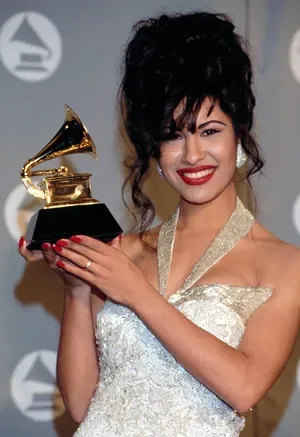
Selena Quintanilla, often called the "Queen of Tejano Music," was the first female Tejano artist to win a Grammy Award in 1994.
She was known not only for her powerful voice but also for her fashion sense, designing many of her iconic performance outfits herself.
Tragically, she was murdered in 1995 at just 23 years old, but her legacy continues to inspire millions around the world.
Achievements & Awards
he also earned multiple Billboard Latin Music Awards and was posthumously honored with a star on the Hollywood Walk of Fame in 2017, solidifying her legacy as one of Latin music’s most influential artists.
Selena Quintanilla, known as the "Queen of Tejano music," received numerous awards throughout her career, including a Grammy Award for Best Mexican-American Album in 1994 for Selena Live!
External Links